If you’re a disabled traveller and/or a wheelchair user, you’ve probably had this experience. You carefully book an “accessible room”, arrive after a long journey, open the door… and immediately realise the hotel’s definition of accessible and your definition are two very different things.
Unfortunately, this happens a lot. The word “accessible” in the hotel industry is wildly inconsistent, and many properties use it very loosely.
Unfortunately, without proper research beforehand, you can find your “Accessible” room comes with:
- The bathroom has a bathtub instead of a roll-in shower.
- Maybe the bed is so high you’d need a stepladder to transfer.
- There’s a step into the bathroom that somehow didn’t count when they labelled the room accessible.
The good news is that with a bit of investigation before booking, you can avoid most of these problems.
Below are some of the most common accessibility traps in hotels and the simple checks that help wheelchair users avoid them.
The Biggest Accessibility Problems Hotels Don’t Tell You About

“Accessible” Rooms With Bathtubs
One of the most common disappointments, in my opinion, is when hotels advertise accessible rooms that still have a standard bathtub with a grab rail and a plastic seat. That might work for some guests with limited mobility, but for many wheelchair users, it’s completely unusable.
A proper accessible bathroom should usually have:
- A roll-in or level access shower
- Fold-down shower seat
- Grab rails in sensible positions
- Enough space to manoeuvre a wheelchair
If the hotel listing doesn’t specifically say roll-in shower, assume it probably isn’t one.
Beds That Are Far Too High
I’ve noticed that some hotel beds have been getting taller every year, while others have been getting shorter. For wheelchair users who transfer independently, this can be a real problem. Some beds are 60–70 cm high, which makes transferring extremely difficult. Especially if using a transfer board. Personally, I prefer a higher bed compared to a lower bed, but this is because of how I transfer in and out of bed. I face the bed from my chair and flop onto it, then swing my legs up onto the bed. Then I do this in reverse when getting out of bed. So having a higher bed actually aids me in transferring.
When doing your/our research, you ideally want to know:
- The height of the mattress (make sure you explain the measurement should be from the floor to the top of the mattress), unless, of course, you want another measurement.
- Whether the bed frame blocks a hoist from going underneath the bed
- If the bed can be lowered or adjusted
Most hotels never mention this unless you ask.
Heavy Fire Doors You Can’t Open
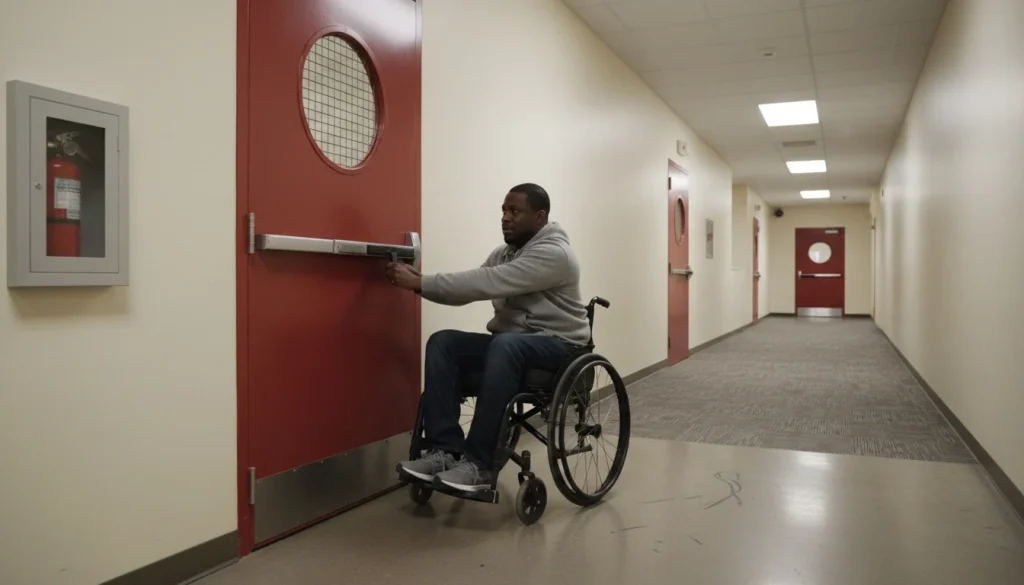
Hotels often have heavy fire doors along corridors or into accessible rooms. My pet hate is a heavy room door into an accessible room. For someone using a manual wheelchair — or even a powerchair — these can be surprisingly difficult to open.
Look out for:
- Automatic door openers
- Lever handles instead of round knobs
- Wide enough corridors to manoeuvre
You don’t want to discover you can’t get into your own room independently.
The “Accessible Entrance” That Isn’t the Main Entrance
Another classic trick. Some hotels advertise step-free access, but when you arrive, you’re directed to a side entrance, delivery door, or staff corridor somewhere around the building. This has happened to me more times than I’d like to mention.
Technically, that is accessible — but it’s not exactly ideal.
It’s worth checking:
- Is the main entrance step-free?
- Are there automatic doors?
- Is the route clearly signposted?
Accessibility shouldn’t feel like sneaking in through the back door, or feeling like a 2nd class citizen!
Steps Inside the Room
This one surprises people, and yes, I have personally come across this. Many years ago, we stayed in a hotel in Cornwall for a weekend. Jeff had booked us an accessible room. However, when we arrived, the main entrance had many steps up to the door, so we had to use the staff entrance. The hallway leading to our room had a massive step halfway down. The patio had a step-up and over threshold.
If this wasn’t enough, I was unable to get into the bathroom as the doorway was too narrow. I was in a manual wheelchair at the time. We complained to reception, and hotel maintenance was sent to our room, who said he could take the door off for me. I explained this would not widen the doorway. The hotel refused to help in any way, claiming we were lying and were just wanting a free room. I’ve never been so insulted, considering we had already explained we didn’t want our money back (I know, we should have), we just wanted them to stop false advertising or rectify the room.
Some hotel rooms have small internal steps or raised bathroom thresholds. They may only be a few centimetres, but that’s enough to stop a wheelchair.
Watch for:
- Raised bathroom entrances
- Sunken living areas
- Balcony steps
Photos can usually reveal these if you look closely.
How Disabled Travellers & Wheelchair Users Can Check Accessibility Before Booking
A few simple checks can save a lot of frustration.
1. Always Contact the Hotel Directly
Never rely entirely on booking sites. Send the hotel a message and ask specific questions about the room layout and bathroom.
Vague answers are often a warning sign.
2. Ask for Actual Photos of the Accessible Room
Hotel websites often use generic marketing photos.
Ask the hotel to send pictures of:
- The bathroom
- Shower area
- Bed height
- Space around the bed
- Doorways
A good hotel will happily send these.
3. Check the Bathroom Layout Carefully
Bathrooms cause the most problems.
Things worth confirming:
- Roll-in shower or bathtub
- Space beside the toilet for transfers
- Grab rail positions
- Sink height and wheelchair clearance
If you can’t visualise the layout, ask the hotel to explain it.
4. Look at Reviews From Disabled Travellers
Sometimes the most useful information comes from other travellers.
Look for reviews mentioning:
- Wheelchair access
- Bathroom accessibility
- Lift size
- Entrance steps
If several wheelchair users mention problems, believe them.
5. Use Street View to Check the Entrance
This is a simple trick many people forget. Google Street View can reveal:
- Steps at the entrance
- Steep ramps
- Cobbled streets outside the hotel
It takes thirty seconds and can save a lot of trouble.
Why Doing This Matters
For most travellers, a bad hotel room is an inconvenience.
For disabled travellers, it can completely ruin a trip, or worst-case scenario, mean going home or looking for alternative accommodation at an extra cost. If the shower isn’t usable or the room layout doesn’t work, you may have no realistic alternative once you arrive, especially in busy tourist areas.
That’s why doing a bit of investigation beforehand is so important.
The Good News: Many Hotels Do Get It Right

While some hotels treat accessibility as an afterthought, others do a genuinely excellent job.
When you find one that does accessibility properly — with a thoughtful room layout, proper roll-in shower, and staff who understand disabled guests — it makes travelling dramatically easier and enjoyable.
And those are exactly the places worth sharing with other travellers. Because when accessibility is done well, it opens the world up.